Introduction
The HAZID and HAZOP form part of the risk assessment process that is required for acceptance by the regulatory bodies.
HAZID is the identification and classification of the hazards.
The risk assessment of the identified HAZID's is conducted continually during design. All possible hazards being identified and recorded as the design progresses.
Periodically, the list of hazards identified will be classified and where actions required / taken to reduce the level / possibility of each hazard occuring will be addressed.
HAZOP is the 'Hazard and Operability'. This is a similar process to the HAZID, however, deals with the affects on the 'system' operation if high or low temperatures / pressures occur.
Notable Projects
Project Name |
Project Number |
Notes |
BAOBAB |
Notable due to the Pipe in Pipe nature |
|
Greater Plutonio |
Deep Water, using SAFEBUCK | |
Qatar Gas |
KW |
Large Diameter Pipe |
Other Projects
Project Name
|
Project Number | Notes |
EPC2B |
KW 0728 |
Controlled Buckles on Existing Pipeline Crossings |
Algeria Pipeline |
KW 1071 |
Onshore |
Deep Panuke |
Codes & Standards
Company |
Title |
Doc Number / Date |
SAFEBUCK JIP |
Safe Design of Pipelines with Lateral Buckling - Design Guideline |
|
DNV |
Global Buckling of Submarine Pipelines |
DNV-RP-F110 |
DNV |
Submarine Pipeline Systems (Strain Based Limit State) |
DNV-OS-F101 |
Course Notes
Author |
Title |
Notes |
C. Sicilia |
Lateral Buckling Assessment and Mitigation Design |
|
Trevor Gee IBC |
Pipeline Course |
Books
Author |
Title |
Chapter |
Mikael Braestrup |
Design and Installation of Marine Pipelines |
6.5 |
Papers
Author |
Title |
Notes |
Hobbes, R. E. |
In-service Buckling of Heated Pipelines, Journal of transportation Engineering, ASCE, Vol. 110, No.2, March 1984, pp. 175-189 |
Approximate method for determining propensity for lateral buckling |
Taylor, N. and Gan, A. B |
Submarine pipeline Buckling – Imperfection Studies, Jour. Of Thin-walled Structures, Vol. 4, 1986, pp 295-323 |
A developed version of ‘Hobbs’, including the effects of initial OOS |
Prepared Calculations
Title / Software |
Description |
Owner / Athor |
Hobbs / Excel |
Predicts the onset of buckling |
KAJW / CSG |
Related Subjects
HAZID / HAZOP
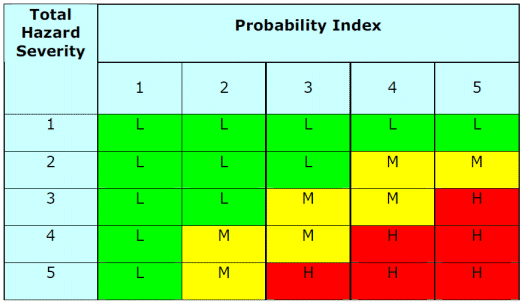
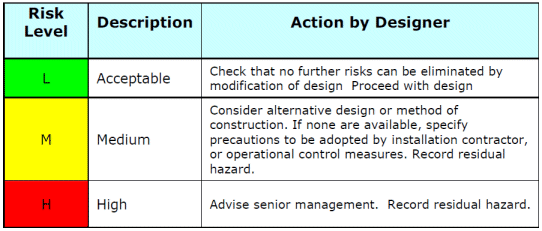
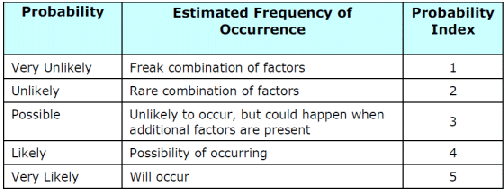
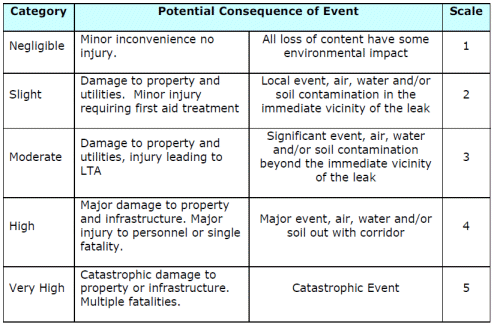
Conducting the hazard risk assessment quantifies each risk identified. One method used for this uses the 4 tables presented here. The 'Severity' and 'Probability' of each item is quantified using the tables above.
Once quantified, the other tables are used to determine the risk level and any required actions.
This process is conducted several times during the design with the intention of reducing all risks to as low as reasonably possible (ALARP).
It also provides a quick reference to highlight an areas that can be considered high risk and therefore require further attention.